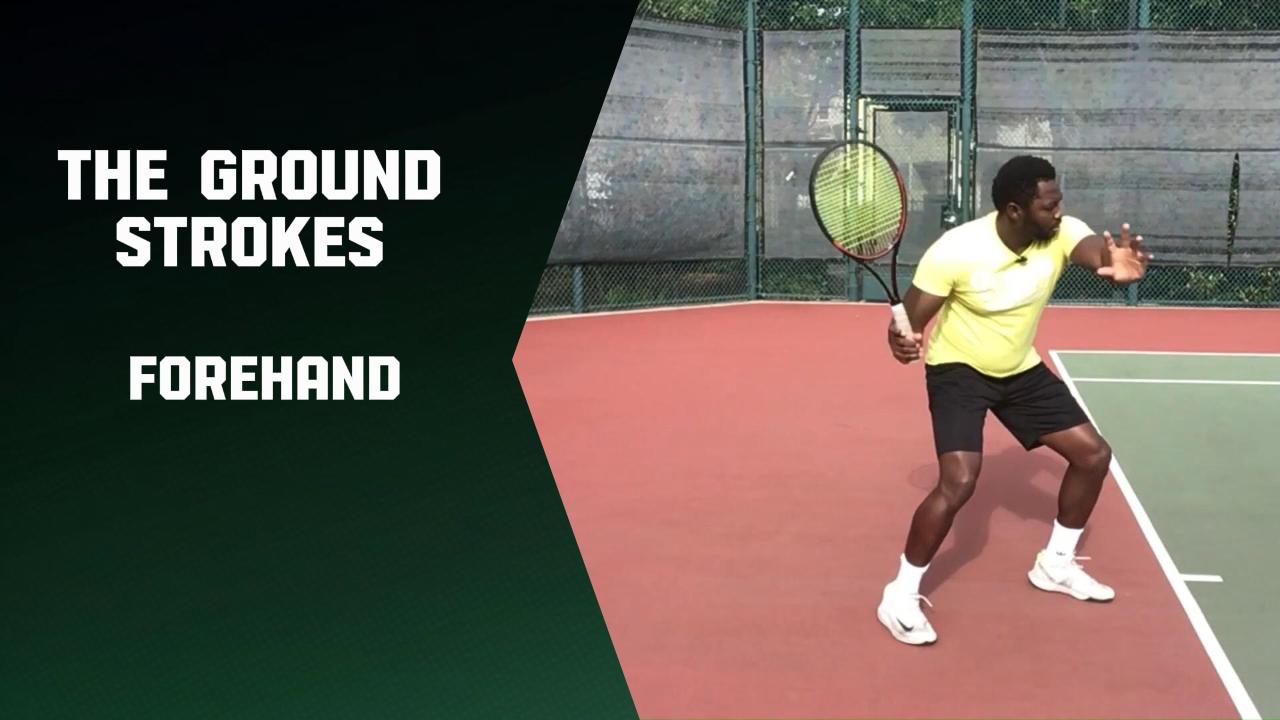
COURSE 3 - THE GROUND STROKES (Forehand)

- Description
- Curriculum
- Reviews
Course Topic
Groundstrokes in tennis are fundamental shots played from the back of the court after the ball has bounced. They are typically categorized into forehands and backhands, each with different techniques and purposes.
Course Objective
The objectives of groundstrokes in tennis revolve around consistency, control, and strategy. Groundstrokes are the backbone of baseline rallies, and players use them to set up offensive opportunities, maintain control of the point, or defend against an opponent’s attack. Here are the primary objectives for groundstrokes in tennis:
1. Control the Baseline
● Objective: Dictate play and dominate the baseline.
● Explanation: Effective groundstrokes allow players to take control of the rally by hitting with power, accuracy, and depth. By controlling the baseline, players can force their opponents into defensive positions and dictate the pace and rhythm of the point.
● Key Focus: Powerful, well-placed shots that push the opponent back or out of position. Players should aim to control the center of the court, giving them better angles and positioning.
2. Control the Baseline
● Objective: Dictate play and dominate the baseline.
● Explanation: Effective groundstrokes allow players to take control of the rally by hitting with power, accuracy, and depth. By controlling the baseline, players can force their opponents into defensive positions and dictate the pace and rhythm of the point.
● Key Focus: Powerful, well-placed shots that push the opponent back or out of position. Players should aim to control the center of the court, giving them better angles and positioning.
3. Force Errors from the Opponent
● Objective: Put pressure on the opponent and induce errors.
● Explanation: Groundstrokes can be used to push opponents out of their comfort zone by varying spin, speed, and placement. By hitting deep and with heavy topspin or changing directions, players can make it difficult for the opponent to return the ball effectively, leading to unforced errors.
● Key Focus: Hitting aggressive groundstrokes, targeting the corners, or using a combination of topspin and slice to disrupt the opponent’s timing and balance.
4. Build Offensive Opportunities
● Objective: Set up points for aggressive play or net approaches.
● Explanation: Groundstrokes are often used to build toward an offensive opportunity, such as hitting a winner or approaching the net. Players look to create openings by hitting deep or wide, forcing their opponent into a defensive stance, and then exploiting that with an aggressive follow-up shot or a net approach.
● Key Focus: Use a combination of shot depth and direction to open up the court and create space for attacking shots or approach shots.
5. Apply and Vary Spin
● Objective: Use different types of spin to control the ball’s trajectory and pace.
● Explanation: Topspin is commonly used in groundstrokes to make the ball dip quickly after crossing the net, allowing players to hit with more power while maintaining control. Slice can be employed to slow the pace or keep the ball low, particularly on defensive shots or to change the rhythm of the rally.
● Key Focus: Master topspin for control and depth, and use slice for low balls and defensive situations.
6. Change Direction and Keep Opponents Off Balance
● Objective: Move the opponent around the court by changing the direction of shots.
● Explanation: By hitting groundstrokes to different parts of the court, players force their opponents to constantly adjust their positioning. Alternating between cross-court and down-the-line shots keeps opponents on the run, tiring them out and making it harder for them to hit effective returns.
● Key Focus: Be unpredictable in shot selection, mixing cross-court shots with down-the-line groundstrokes.
7. Control Depth and Pace
● Objective: Hit groundstrokes with the right balance of depth and pace to control rallies.
● Explanation: Groundstrokes that land deep near the baseline are harder to return and often force the opponent to hit off the back foot, putting them on the defensive. Varying the pace of shots also prevents the opponent from getting into a rhythm, making it harder for them to anticipate and return shots effectively.
● Key Focus: Hit groundstrokes that land deep in the court, mixing in faster and slower shots to control the pace of the rally.
8. Transition from Defense to Offense
● Objective: Use groundstrokes to turn a defensive situation into an offensive one.
● Explanation: When under pressure, players use defensive groundstrokes (often with extra topspin or a higher trajectory) to neutralize the rally and get back into a stronger position. Once stabilized, they can switch to a more aggressive groundstroke to take control of the point.
● Key Focus: Focus on hitting deep, high-margin shots while on defense, then look for opportunities to hit flatter, more aggressive shots when possible.
9. Exploit Opponent’s Weaknesses
● Objective: Target the opponent’s weaker side or exploit their lack of mobility.
● Explanation: Groundstrokes allow players to strategically hit to the opponent’s weaker side (often the backhand) or force them to cover more court. This tactic increases the likelihood of the opponent making an error or hitting a weaker return.
● Key Focus: Identify the opponent’s weaker side or movement limitations, and repeatedly target those areas with precise groundstrokes.
The objectives of groundstrokes in tennis are multi-faceted, encompassing consistency, control, strategy, and adaptability. Whether used to dictate the pace of a rally, force errors, or exploit an opponent’s weaknesses, effective groundstrokes are critical to success on the tennis court. By mastering these objectives, players can dominate baseline exchanges and gain a competitive edge.
Course Expectation
Expectations regarding groundstrokes in tennis depend on the player’s skill level, style of play, and strategic goals. Groundstrokes are fundamental to the sport, and their effectiveness often determines success in matches. Here are some common expectations for groundstrokes, both for players and coaches:
1. Consistency
● Expectation: Players are expected to maintain consistency in their groundstrokes, especially during baseline rallies.
● Explanation: Groundstrokes should be reliable, with minimal unforced errors. This means keeping the ball in play, hitting with enough topspin to avoid mistakes, and avoiding over-hitting or under-hitting. At higher levels, consistency is vital for sustaining long rallies.
● What to Work On: Focus on technique, proper footwork, and timing to develop consistent groundstrokes that can last through long points.
2. Depth and Control
● Expectation: Groundstrokes should regularly land deep in the court, pushing the opponent back and giving the player control of the point.
● Explanation: Deep shots are harder to attack and allow players to dictate the pace of the rally. Hitting short groundstrokes frequently gives the opponent a chance to move forward and put pressure on you.
● What to Work On: Practice hitting groundstrokes that land near the baseline while maintaining control. Develop a feel for varying shot depth without sacrificing consistency.
3. Power with Precision
● Expectation: Groundstrokes should combine power with accuracy, striking a balance between aggressive shot-making and control.
● Explanation: As players advance, more is expected in terms of power, but power alone is insufficient without the ability to place the ball accurately. The goal is to hit powerful shots that land in difficult spots for the opponent (e.g., corners or deep shots near the sidelines).
● What to Work On: Focus on generating power from the legs and core, with controlled acceleration through the ball, and target key areas of the court.
4. Spin and Variety
● Expectation: Players are expected to apply different spins to their groundstrokes, such as topspin and slice, to control the ball’s trajectory and keep opponents off balance.
● Explanation: Topspin allows for high-margin shots that dip quickly into the court, while slices can be used to keep the ball low and disrupt the opponent’s rhythm. Being able to mix up spins adds variety to the game, making it harder for opponents to predict your shots.
● What to Work On: Develop a low-to-high racket swing for topspin, and practice high-to-low swings for slice. Learn to vary the spin based on the situation in a match.
5. Control of Pace
● Expectation: Players are expected to control the pace of their groundstrokes, knowing when to accelerate the ball and when to slow it down.
● Explanation: Controlling the speed of groundstrokes is crucial for dictating play. Players should be able to hit fast, aggressive shots when on the attack and slow down the pace when necessary to neutralize the opponent’s aggression or buy time to recover.
● What to Work On: Practice hitting with varied speeds. Learn to read the situation, hitting with more pace when attacking and slowing down when defending.
6. Directional Control
● Expectation: Groundstrokes should be directed to different areas of the court, forcing the opponent to move and creating opportunities to exploit openings.
● Explanation: Hitting groundstrokes cross-court and down-the-line accurately is an important expectation at all levels. By changing direction and angles, players can disrupt their opponent’s positioning and create space to hit winners.
● What to Work On: Improve shot placement by practicing both cross-court and down-the-line shots with control and accuracy.
7. Adaptability to Different Court Surfaces
● Expectation: Groundstrokes should be adaptable to different playing surfaces (hard courts, clay, grass) where the bounce and pace of the ball vary significantly.
● Explanation: Different surfaces affect the behavior of groundstrokes. On clay, for example, topspin is more effective due to the higher bounce, while on grass, slices are often more effective because the ball stays low. Players are expected to adjust their shot selection and technique based on the surface.
● What to Work On: Practice on different surfaces and focus on the nuances of how groundstrokes need to be adjusted, such as using more topspin on clay or relying more on flatter strokes on faster surfaces like grass or hard courts.
8. Effective Footwork
● Expectation: Players are expected to have quick, efficient footwork to position themselves correctly for groundstrokes.
● Explanation: Good footwork is crucial for setting up properly before hitting a groundstroke. Players need to move quickly and efficiently to get into the right position, especially when under pressure.
● What to Work On: Focus on footwork drills that improve agility and the ability to move laterally and recover after each shot. Split steps and proper body positioning are key elements.
9. Transition Between Defense and Offense
● Expectation: Players are expected to use groundstrokes to transition smoothly between defense and offense during rallies.
● Explanation: Groundstrokes play a key role in switching from a defensive position (such as when the opponent hits a powerful shot) to an offensive position (when an opportunity arises to take control of the rally). Defensive shots may involve more spin or height to buy time, while offensive shots are flatter and aimed at taking control.
● What to Work On: Learn to identify when to switch from a defensive to an offensive mindset during rallies. Practice hitting defensive groundstrokes high and deep, and follow up with more aggressive groundstrokes when the opportunity presents itself.
10. Mental Focus and Shot Selection
● Expectation: Players are expected to make smart shot selections based on their positioning, the opponent’s positioning, and the situation in the match.
● Explanation: Groundstrokes are not just about power and technique; shot selection plays a huge role in success. Players are expected to hit the right shot at the right time—whether it’s a defensive slice, a neutral rally shot, or an aggressive forehand down the line.
● What to Work On: Develop the mental discipline to make the right decisions under pressure. Practice selecting shots based on the court position and game situation during practice matches.
11. Recovery After Each Shot
● Expectation: After hitting groundstrokes, players are expected to quickly recover and return to a neutral or strong court position.
● Explanation: Recovery is essential to be ready for the next shot. After hitting a groundstroke, players should reposition themselves in the center of the court or the optimal place to cover their opponent’s next shot. Poor recovery often leads to being caught out of position.
● What to Work On: Develop good recovery habits by practicing footwork drills that emphasize moving back to the center of the baseline after each shot. Focus on staying balanced after hitting.
12. Control Under Pressure
● Expectation: Players are expected to maintain control of their groundstrokes even when under pressure.
● Explanation: In tight situations, whether facing a breakpoint or in a long rally, players need to stay composed and avoid reckless or forced errors. Groundstrokes should remain controlled, with the appropriate use of spin and placement.
● What to Work On: Practice high-pressure scenarios during training to develop the ability to stay calm and hit controlled groundstrokes even when facing difficult situations.
The expectations for groundstrokes in tennis are centered around consistency, control, power, and adaptability. As players advance, they are expected to refine their groundstroke technique, improve shot placement, manage different court surfaces, and handle pressure effectively. Meeting these expectations allows players to compete at a higher level and excel in all areas of baseline play.
Course Details
Groundstrokes are fundamental shots in tennis that are executed after the ball has bounced on the court. These shots form the basis of baseline rallies, and mastering them is essential for success in the sport. Here’s an in-depth look at groundstrokes in tennis:
Types of Groundstrokes
Groundstrokes are generally categorized into two main types: forehand and backhand.
What is a Forehand Groundstroke
The forehand in tennis is a fundamental groundstroke where the palm of your hitting hand faces forward, leading the swing across your body. It is generally considered the easiest and most natural shot to master, making it the primary offensive weapon for both beginners and elite professionals.
The forehand is a groundstroke hit after the ball bounces once on your side of the court. Right-handed players normally hit forehands on the right side of their body, while left-handed players hit them on the left side.
A forehand in tennis is one of the most important and powerful shots in the game. It is usually played with the front side of the racket hand facing the ball, and for most players it is their strongest and most natural stroke.
Key Parts of a Good Forehand
Common Grip Styles
Your choice of grip dictates the racket face angle, which heavily influences the spin and depth of your shot.
-
Eastern Grip: The classic style where your palm rests flat against the back of the handle. It is ideal for hitting flat, fast, and low-skimming shots.
-
Semi-Western Grip: The most common grip in the modern game. It is excellent for generating a balance of high power and heavy topspin.
-
Western Grip: An extreme grip where the hand sits underneath the handle. It produces massive topspin and handles high bounces well, but makes low balls difficult to hit.
Preparation
-
Turn your shoulders sideways
-
Take the racket back early
-
Keep your eyes on the ball
Mechanics of the Swing
A successful forehand relies on the kinetic chain—transferring energy from the ground up through your legs, hips, torso, and finally into your arm.
-
Unit Turn: As the ball approaches, rotate your shoulders and hips together while keeping both hands on the racket to prepare early.
-
Racket Drop: Drop the racket head down below the height of the incoming ball to establish a low-to-high swing path.
-
Contact Point: Strike the ball slightly out in front and to the side of your body. Your racket face should be perfectly square to your target at impact.
-
Extension and Follow-Through: Extend the racket forward through the “hitting zone” toward your target before relaxing and letting it naturally finish across your opposite shoulder.
Core Pro Tips
-
Stay Loose: Avoid squeezing the racket handle too tightly. A relaxed grip maximizes racket head speed and creates natural ball-crushing power.
-
Use Your Non-Dominant Hand: Extend your non-hitting arm parallel to the baseline during your turn to assist with balance, spacing, and tracking the ball.
-
Prioritize Depth Over Pace: Focus on hitting the ball deep into the opponent’s court rather than hitting it as hard as you can. Depth keeps opponents on the defensive.
To help tailor this, what is your current experience level with tennis? If you are troubleshooting your stroke, let me know if you are struggling with control, power, or hitting the net.
Types of Forehands
-
Topspin Forehand — dips quickly into the court and bounces high
-
Flat Forehand — faster and more aggressive
-
Slice Forehand — softer shot with backspin
-
Inside-out Forehand — hit from the backhand corner toward the opponent’s backhand side
Why the Forehand is Important
The forehand is often used to:
-
Control rallies
-
Create winners
-
Push opponents out of position
-
Attack short balls
Many legendary players built their game around powerful forehands, including Roger Federer, Rafael Nadal, and Novak Djokovic.
Simple Description
“A forehand is an offensive tennis shot played from the dominant side of the body using a forward swinging motion to generate power, spin, and control.”
Variations of Groundstrokes
Groundstrokes can be further classified based on the spin, speed, and trajectory of the shot:
-
Topspin Groundstrokes:
-
Mechanics: The racket follows a low-to-high swing path, brushing up on the ball to create spin. Topspin allows the ball to arc higher over the net and then drop sharply, giving more control and depth.
-
Advantages: Greater margin for error and consistency in longer rallies; allows players to hit aggressive shots with less risk of the ball going out.
-
-
Flat Groundstrokes:
-
Mechanics: These shots are hit with little or no topspin, resulting in a flatter trajectory. The ball travels faster but with less margin for error compared to topspin shots.
-
Advantages: Flat groundstrokes are powerful and penetrate through the court, making it harder for the opponent to react quickly.
-
-
Defensive Groundstrokes:
-
Mechanics: These are hit with the intention of prolonging the rally, often with more topspin or height to allow the player more time to recover.
-
Use: Employed when the player is under pressure or out of position.
-
-
Aggressive Groundstrokes:
-
Mechanics: These shots are struck with more power and usually with a lower trajectory over the net to force the opponent into a defensive position.
-
Use: Used to dictate play, create openings, or finish points.
-
Role of Groundstrokes in Strategy
● Baseline Play: Groundstrokes form the core of baseline play, which dominates modern tennis. Players trade forehands and backhands from the baseline, often looking for an opportunity to attack or force errors.
● Shot Variety: Effective groundstroke play involves mixing up spin, pace, and direction to keep the opponent off balance. Consistent and powerful groundstrokes can dictate the flow of a match.
Drills for Improving Groundstrokes
-
Cross-Court and Down-the-Line Drills: Practice hitting forehand and backhand shots cross-court and down the line to improve accuracy and consistency.
-
Topspin vs. Flat Drills: Alternate between hitting topspin and flat shots to develop versatility.
-
Footwork Drills: Incorporate shadow swings, ladder drills, and lateral movements to improve speed and positioning.
Groundstrokes are the foundation of a player’s game, especially in modern baseline-dominant tennis. Whether focusing on topspin, flat shots, or slice, a well-rounded groundstroke game allows players to stay consistent, create opportunities, and dominate rallies. Mastering both forehand and backhand groundstrokes is essential for players at all levels.


-
19
 Introduction To The Forehand Preparation
 -
20
How To Take The Racquet Back In The Forehand Preparation
-
21
The Racquet Angles In The Forehand Preparation
-
22
The Body Turn In The Forehand Preparation
-
23
The Arm Or Elbow Position In The Forehand Preparation
-
24
The Right Wrist Position In The Forehand Preparation
-
35
Introduction To The Forehand Contact
-
36
Where To Make Contact In The Forehand
-
37
The Body Rotation In The Forehand Contact
-
38
Keeping The Eyes On The Ball In The Forehand Contact
-
39
The Contact Point In The Forehand
-
40
The Wrist Position In The Forehand Contact
-
41
The Elbow Position In The Contact
-
42
The Racquet Angle In The Forehand Contact
-
43
The Racquet Acceleration In The Forehand Contact
-
44
The Early And Late Contact In The Forehand
-
45
Introduction To The Forehand Follow Through
-
46
How To Create The Forehand Follow Through
-
47
The Racquet Angle In The Forehand Follow Through
-
48
Where To Keep The Racquet In The Forehand Follow Through
-
49
Keeping The Left Hand On The Racket In The Forehand Follow Through
-
50
Conclusion To The Forehand